What is Open Web Analytics (OWA)?
Open Web Analytics (OWA) is an open-source web analytics software that allows website owners to track and analyze visitor behavior on their websites. It offers many features that can help you gain insights into your website’s performance and make data-driven decisions about your marketing and website strategies.
Open Web Analytics Dashboard
Open Web Analytics (OWA) provides a dashboard that offers a quick and easy way to access and analyze key metrics related to your website’s performance.
The dashboard includes several reports, such as the E-commerce Report, which provides insights into your website’s sales and revenue. The Content Report helps you analyze which pages on your site are most popular and engaging, while the Action Tracking Report allows you to track specific actions taken by visitors, such as form submissions or clicks on a particular button. The Visitors Report provides information on visitor behavior, including how many people are visiting your site, how long they are staying, and where they are coming from. The Traffic Report, on the other hand, provides insights into how visitors are finding your site, whether it’s through search engines, social media, or other channels. Finally, the Goals Report allows you to track progress towards specific objectives, such as sign-ups, downloads, or other conversion actions.
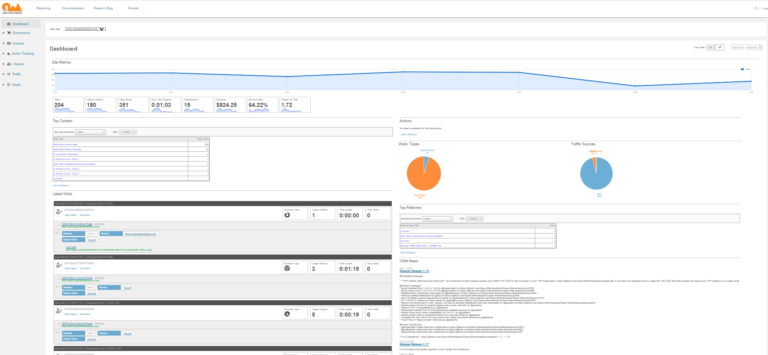
You can see more and familiarize yourself with the Demo.
Open Web Analytics Benefits
Here are some additional benefits of using OWA:
- Data privacy: Since OWA is installed on your own server, you have full control over your data and can ensure that it’s kept private and secure.
- Customization: OWA is highly customizable and can be configured to track the metrics that matter most to you.
- Open-source: OWA is an open-source tool, which means that you have access to the source code and can modify it to suit your needs.
- Real-time analytics: OWA provides real-time data on visitor behavior, allowing you to see what’s happening on your website in real time.
- Attribution tracking: OWA allows you to track and analyze how visitors interact with your website and attribute conversions to specific channels or campaigns.
Open Web Analytics vs Google Analytics 4
According to Wappalyzer, OWA has been installed on over 12,700 websites. While this is a relatively small number compared to Google Analytics 4 (GA4), which is used on over 5 million websites, OWA is still a powerful and popular tool for website owners who value data privacy and control.
- Ownership and control: OWA is open-source software that you can install and run on your own web server, giving you full control over your data. On the other hand, Google Analytics is owned and controlled by Google, which means that you are dependent on their platform and subject to their terms of service.
- Cost: OWA is free and open-source, while Google Analytics has a free version (with limited features) as well as a paid version (with more advanced features).
- Data privacy: Since OWA is self-hosted, all data is stored on your own server, which can give you more control over your data privacy. In contrast, Google Analytics sends data to Google’s servers, which may raise concerns for some users.
- Features: Google Analytics has a wide range of features, including advanced reporting and data visualization tools, as well as integrations with other Google services. OWA has fewer features but still provides basic visitor tracking and reporting capabilities.
In summary, while OWA may not have the same level of adoption as GA4, it’s still a powerful and popular tool for website owners who value data privacy and control. Its server-side tracking method offers several advantages over client-side tracking tools, and its customization options make it a flexible tool for tracking the metrics that matter most to you.
Conclusion
In conclusion, Open Web Analytics (OWA) is a powerful open-source web analytics software that provides website owners with a range of features to track and analyze visitor behavior. The customizable dashboard includes reports on e-commerce, content, action tracking, visitors, traffic, and goals, allowing for real-time analysis and attribution tracking. OWA’s server-side tracking method provides data privacy and ownership, making it a popular tool for those who value control over their data.
Credit should be given where it’s due, and Peter Adams deserves recognition for his work on Open Web Analytics (OWA). As the lead developer of OWA, he has played a crucial role in creating and maintaining this powerful and popular web analytics tool. Thanks for bringing this up!